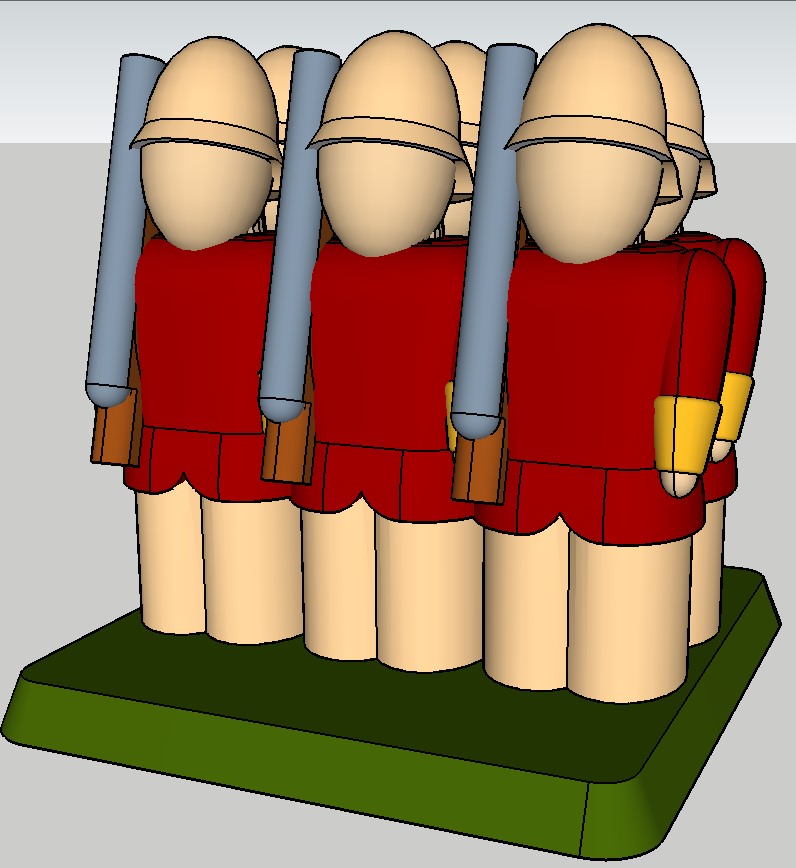
One of the blessings in disguise of 3D printing is that the process isn’t perfect. Sometimes models fail for unexpected and unexplained reasons. If the errors aren’t too catastrophic, this leaves you with a small number of otherwise useless models. These make great test subjects for painting. I gave two failed prints a quick mockup. Cieland's light and dark blue was up first. The first step was ensuring I don't want white pants/helmets. The white pants and helmet looks very tropical. My terrain is more arid than tropical.
Wargaming in small spaces with small budgets. Most games are grid-based with custom 3D printed miniatures.
Sunday, December 12, 2021
Quick Paint Tests
Monday, December 6, 2021
Cieland Uniform Plates
Similarly to Sicora, the Cieland uniform design is committed, but the color scheme is not. All units in the Cielandic Army wear short tunics and pickelhaube helmets. To be most historically accurate, the tunic should be dark blue and the trousers should be dark gray. If my modeling skills are sufficient, they should invoke a Prussian impression. I do like the Prussian color scheme and it would contrast well with the bright red Sicoran uniforms, but the bright blue uniforms from my 18th Century army (featured in late 2018) still capture my imagination. Striking a balance between being able to use the force in historically inspired and purely imagi-nation settings is proving difficult.
Bright blue would have been a historically difficult proposition. Bright blue dyes were very expensive compared to red, yellow, or natural shades. Outfitting an entire army in bright blue would have been very expensive, leading most countries to use a cheaper dark blue dye or avoid it entirely. I am leaning towards going full imagi-nation. In an imagi-nation setting, it is very easy to rationalize a cheaper light blue dye or a reason for the nation to be wealthy enough to afford enough expensive dye to uniform the army.
| Prussian Infantry for Reference |
| Regular Pattern |
| Possible Guard Uniform |
| Tropical Pattern |
Tuesday, November 30, 2021
Sicoran Uniform Plates
I have good news to report. Troops from two separate armies have been printed and primed. Each force is comprised of four units of regular infantry, a field artillery battery, and a cavalry detachment. Six tiles of forest coverage and a pair of one tile built-up-areas. This is the bare minimum to play a reasonable game of The Portable Wargame, One Hour Wargames, and my own rules in development. One of the forces is inspired by the British army of 1870. This force will become Sicora as described in a previous post.
I'd like to ensure that my units are clearly inspired by British uniforms, but won't be strictly adhering to historical uniforms. I'm steering away from the historically correct home service navy blue pants and helmet. The other army is wearing pickelhaube helmets and I'd like them to have navy blue helmets and pants with a brighter (roughly Bavarian) blue tunic. For the same reason, I'll also be omitting the fact that artillery and cavalry troops wore blue tunics. Possible uniform options are shown below. Units will be differentiated by cuff color and/or marked on the base, I still haven't decided. I greatly appreciate any feedback and/or preferences.
![]() |
| Probably closest to Home Service Uniform |
![]() |
| White helmets to blend all-black and all-white |
![]() |
| This option may be too "Napoleonic" for 1870 |
![]() |
| Iconic Campaign look with early khaki |
Tuesday, November 9, 2021
Hot off the press
Progress is being made. I have printed functional test prints of pickelhaube wearing cavalry and infantry as well as pith helmet wearing artillery.
| Primed artillery, infantry, and unprimed cavalry |
| The wheels printed quite wobbly |
| Top view: infantry in forest |
| Front view: infantry in forest |
| Primed Infantry |
The terrain shown in previous posts has also been test printed and is awaiting priming. I have not yet attempted painting, but am realizing there are going to be a lot of hard to reach areas. The undersides of the artillery pieces and transitions between legs and bases look especially challenging. I should have realized this during my design phase, but it didn't occur to me. One option is to remove the bases and print the grouped figures as one piece and then attach to a base later. Unbased figures are appealing if I want to commit to gridded games that don't need a base anyway, but one of my primary goals for this project was to keep flexibility.
Another option would be to leave an indentation in both the base and figures to fill with small magnets. With two small kids running around, I don't like this option. My 2.5 year old daughter loves to pick up the test prints and admire them (at least I have one fan). Once she's a little older I'll probably be designing a teddy bear army for her. Ganesha Games sells a very compelling introductory wargame which I think she'd like (https://www.ganeshagames.net/product_info.php?products_id=13). I'll probably end up sticking with the pre-based figures and just deal with the difficult painting.
Thursday, November 4, 2021
Introducing The Combatants
Friday, October 29, 2021
Deciding to not decide
Wednesday, October 27, 2021
Get on with it!
I'm moving forward 3D printing and painting forces for the Colonial version of his rules. I can squeeze 25mm figures on 30mm bases. This balances my terrible painting skill with my desire to maintain a compact game. 3D printing my forces is also cheaper for me than buying lead or plastic figures. Assuming the printer is paid for through other hobby enjoyment or sales of other things printed (it is), a stand of 3 25mm cavalry figures (base included) costs me less than $.50 USD. I don't think I could get that kind of deal elsewhere. However, I have to compromise on detail to make this work. My 3D printer cannot handle some of the more detailed models at 28mm or smaller meaning I have to do the design work myself. I think this compromise is more than fair for most games.
This is my first attempt at designing units with a built-in base. I prefer the look of non-based units but, based units give the flexibility to be used in gridded games as well as free moving games that require units to be in base to base contact. All of my units are designed to print with significant overlap between individual soldiers. This improves their ability to be printed, reduces my painting workload, and provides a more massed look. The cavalry and line infantry will very nearly fill the base width, but no parts of them exceed the base.
| 25mm tall figures on 30mm square bases |
The next step is determining which nationalities/conflicts I'd like to represent. I'm not opposed to getting into what-if scenarios and imagi-nation actions, but I'm limiting myself to one set of terrain for now. Doubling the amount of time painting terrain and designing two sets of trees/buildings/cover just isn't appealing right now. Perhaps eventually the forces will deploy to more exotic locales but for now all splendid little wars will all be fought in similar climates. I'm leaning towards a brown/sand board with terracotta tile roof and stucco buildings. This could be used from the Mediterranean, to the Southern US/Mexico, and even Spanish Colonies in the Caribbean or Pacific. I think this gives me the best "bang for the buck".