Friday, February 10, 2023

One Turn of "The Far Side of the World"

In this post and the next, I'll try to walk through a single turn of "The Far Side of the World".  I don't have painted models and terrain yet so this will be a virtual walkthrough.

Situation:

You take the role of Sir Raymond Byrne, an inexperienced Colonel serving your first command tour.  Your Red army is marching through the countryside on when you contact a vanguard of the enemy army preparing to fortify a farmhouse.  You immediately proceed to attack, attempting to prevent the enemy from becoming entrenched.  A few turns into the battle, lines have formed and troops are engaged.

The mostly-barren battlefield

Your Forces:

You command 3 companies of regular infantry, a light infantry company, and a detachment of field artillery. On your left flank, the light infantry company take up a position in the woods.  Although they can still be seen by the enemy, the trees provide cover.  Immediately to your flank is the a regular infantry company with green facings and cuffs.  You are positioned in the middle of the line with your unit of elite regular infantry (white cuffs). The third company (black cuffs) are on your right. The artillery detachment has positioned themselves on the hill where they can shoot at the enemy overhead the black company.

Red's Position

The Enemy Forces:

The enemy commander sits atop his black charger with the a squadron from the first heavy horse regiment.  He has had an illustrious career on horseback and has earned the Equestrian trait.  On his left is a squadron of regular saber cavalry.  Two companies of regular infantry (gold cuff and red cuff) form the center and left of the main line.  A company of militia regular infantry occupy the farmhouse. 


Blue's Position

The Action Continues:

The player must decide which units to activate first.  Due to the leader's "Green" trait, all units with command radius suffer a -1 modifier to all resolve rolls. The skirmish infantry in the woods are outside command radius and therefore have the highest likelihood of successful activation.  The player chooses to attempt to activate them first. 
The player rolls 2D6, resulting in a sum of 8.  From this unmodified sum, baseline and conditional modifiers are added.  The baseline modifier for activation is the difference between the unit's resolve and 3.  The skirmish infantry has a resolve of 3.  Offsetting resolve and no conditional modifiers results in a modified result of 8.  The skirmishers are awarded a simple action.  They move forward 2 cells. 

Skirmishers vacate the woods

The player may now activate another unit.  All line infantry would receive a +1 modifier for being adjacent to the leader.  The artillery being at a diagonal is counted as being 2 cells from the leader. (When counting distances in "The Far Side of the World", every 1st, 3rd, 5th, Nth, diagonal measurements is counted as a distance of 2.) The player nominates the leader's elite regular infantry for activation.
The player rolls 2D6, resulting in a sum of 10. The baseline modifier for activation is the difference between the unit's resolve and 3.  The regular infantry has a resolve of 3.  The regulars receive a +1 bonus for being adjacent to the leader, resulting in a modified result of 11.  They are awarded a difficult or easy action.  Because units are not permitted to move and fire in the same activation, using the "Volley Fire" action is the best course of action.
The yellow-cuffed regular infantry in the forest is determined to be the target.  It is established that there are no Line of Sight obstructions and the target is in range (range is 3).  Because the leader's unit is involved in the combat, the player rolls 2D6 for the unit and 1D6 for the leader. The player must use the leader's dice but chooses the best of the unit's dice, resulting in a sum of 11.  The baseline modifier for shooting combats is the difference between the shooting unit's combat (3) and the target's resolve (3).  The elite regulars receive a +1 modifier for performing the volley fire action, a -1 modifier for shooting at maximum range, and a -1 modifier for the target in cover.  The modified result is 10.  The firing results in the regulars becoming disordered and bloodied.  (Blue may activate its leader unit who can attempt to rally the yellow-cuffed regulars, but the bloodied modifier cannot be removed) 

Elite Regulars fire at regulars in forest

The player may now choose to activate another unit.  They select the green-cuffed regulars between the skirmishers and Sir Byrne's Elite Regulars to maximize volume of fire pouring into the farmstead in subsequent turns, the player attempts to activate the green-cuffed regulars. The player rolls 2D6 resulting in a sum of 2.  No amount of modifiers will result in an activation.  Because there are no ongoing melees to check for resolution, initiative moves to the blue player.

END OF RED'S TURN

NOTES: 
Changes to results table forthcoming.  Results in v1.0 unclear.  Results of 10+ will be "Target bloodied and disordered. If already bloodied and disordered, eliminated."
Rally attempts can be influenced by leader and unit traits.  Probably need to pick one.
"Veteran" and "Green" should apply to all resolve in v1.0.  Consider changing to only impact to activation in v1.1

I'll write up Blue's activation next.  I should be able to demonstrate melee actions and the effects of units being disordered and bloodied.

Tuesday, February 7, 2023

Introducing "The Far Side of the World"

 Although I haven't posted in a long time, I haven't been completely idle.  I've been developing my own compact, gridded, limited bookkeeping wargame.  My efforts developed into the rules now posted in the pages section of this blog.  

 It is intended to cover the time period 1840-1900.  Each stand of units is intended to represent roughly a company of infantry, squadron of cavalry, and single guns.  However, if players assume the artillery is larger field places or the nations involved preferred to form larger batteries, the scale could easily be upgraded so that infantry represents regiments.  

If you play the game or read through the rules and have feedback, please do not hesitate to reach-out.  

I still have some horses to paint and need to add most of the details to the other units before I’m able to play a game worth photographing. I’ve played it digitally through the software I did the modeling in but it’s supposed to be a tactile game. Right?

I will try to be a little more diligent in getting the painting done and getting games on the the table. 

Sunday, December 12, 2021

Quick Paint Tests

I am making slow progress on getting my mid/late 19th century armies to the table. I am still undecided about color schemes but wanted to see some options side by side.  Below are some examples of what I've already painted.  

I had some other football players, but none looked appropriate

I completely forgot that I had already painted a light and dark blue army.  After seeing it next to some other options, I think it fits well as a military uniform.  I really like the green uniforms, but I need to use most of my greens on foliage. The football player is from Techno Bowl, probably the best game I've ever played.  It's a great mix of luck, strategy, and customization.  The only downside is that it is impossible to play solo well.

One of the blessings in disguise of 3D printing is that the process isn’t perfect. Sometimes models fail for unexpected and unexplained reasons. If the errors aren’t too catastrophic, this leaves you with a small number of otherwise useless models. These make great test subjects for painting. I gave two failed prints a quick mockup.  Cieland's light and dark blue was up first.   The first step was ensuring I don't want white pants/helmets.  The white pants and helmet looks very tropical.  My terrain is more arid than tropical.  


After adding dark blue paint to the helmet and pants, the uniform looks decidedly less tropical.  Completing the model with flesh tone faces, brown and silver firearms, gold spikes on the pickelhaube, and regimental cuffs, will yield a viable Cielandic uniform.  

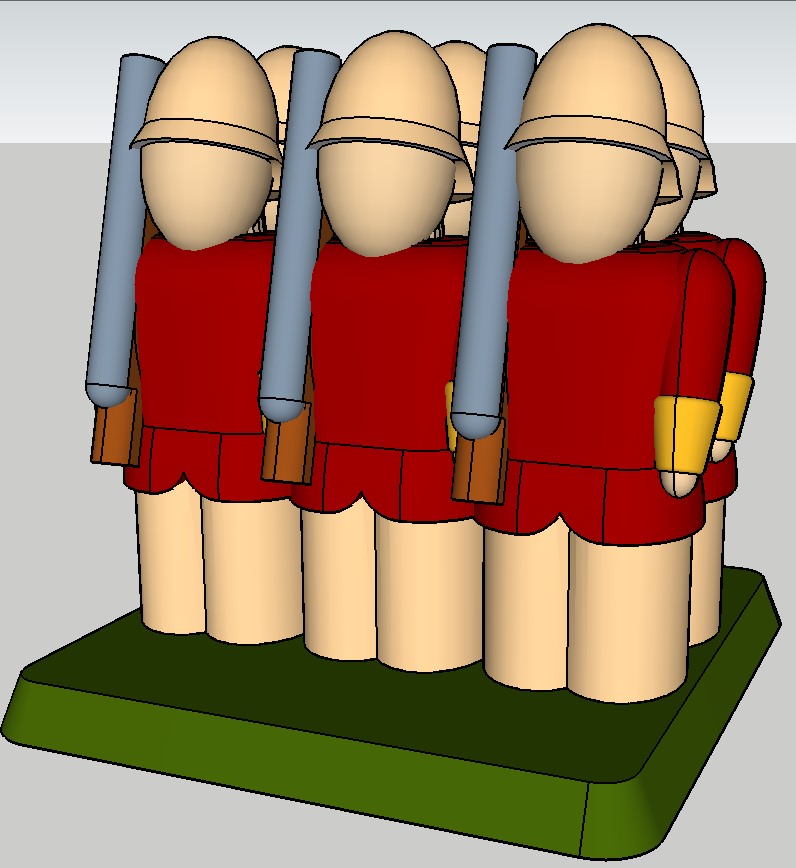
Sicora's red uniform is up next.  It is intended to be roughly inspired by Victorian Great Britain.  I'm not striving for complete imitation, it just needs to look British enough that it could be used in a historically inspired scenario.  As with the other uniform, I started by painting the Tunic and then adding color and evaluating the combinations along the way.


The all white uniform could be OK but it looks rather Napoleonic to me.  By the mid/late 19th Century most European nations had moved away from white pants.  I can't imagine trying to keep a white uniform looking good in the field.


I didn't have any khaki paint available so I had to move straight to Home Service Uniforms.  I know the late 19th Century Home Service Uniform had a spike on the helmet, but with my impressionistic (low detail) modeling the only uniform difference would be the height of the helmet. I like this scheme better.  It really helps develop the toy soldier look I want and keeps me from developing theater specific uniforms.  


The photo above shows the sample models at roughly 3 feet.  They look distinct enough for me.  I don't really like how "symmetric" the uniforms are, but I don't know how to fix it.  I opted out of light color pants for both.  I could probably reverse Cieland's tunic and pants color, but if I expand the line in the future, France and/or US would be next.  Reversing Cieland's scheme would very closely mimic US uniforms.  


Monday, December 6, 2021

Cieland Uniform Plates

 Similarly to Sicora, the Cieland uniform design is committed, but the color scheme is not.  All units in the Cielandic Army wear short tunics and pickelhaube helmets. To be most historically accurate, the tunic should be dark blue and the trousers should be dark gray.   If my modeling skills are sufficient, they should invoke a Prussian impression.  I do like the Prussian color scheme and it would contrast well with the bright red Sicoran uniforms, but the bright blue uniforms from my 18th Century army (featured in late 2018) still capture my imagination.  Striking a balance between being able to use the force in historically inspired and purely imagi-nation settings is proving difficult.  

Bright blue would have been a historically difficult proposition.  Bright blue dyes were very expensive compared to red, yellow, or natural shades.  Outfitting an entire army in bright blue would have been very expensive, leading most countries to use a cheaper dark blue dye or avoid it entirely. I am leaning towards going full imagi-nation. In an imagi-nation setting, it is very easy to rationalize a cheaper light blue dye or a reason for the nation to be wealthy enough to afford enough expensive dye to uniform the army.  

Prussian Infantry for Reference
  

Regular Pattern

Possible Guard Uniform

Tropical Pattern


Tuesday, November 30, 2021

Sicoran Uniform Plates

I have good news to report.  Troops from two separate armies have been printed and primed.  Each force is comprised of four units of regular infantry, a field artillery battery, and a cavalry detachment. Six tiles of forest coverage and a pair of one tile built-up-areas.  This is the bare minimum to play a reasonable game of The Portable Wargame, One Hour Wargames, and my own rules in development. One of the forces is inspired by the British army of 1870. This force will become Sicora as described in a previous post.  

I'd like to ensure that my units are clearly inspired by British uniforms, but won't be strictly adhering to historical uniforms. I'm steering away from the historically correct home service navy blue pants and helmet. The other army is wearing pickelhaube helmets and I'd like them to have navy blue helmets and pants with a brighter (roughly Bavarian) blue tunic. For the same reason, I'll also be omitting the fact that artillery and cavalry troops wore blue tunics. Possible uniform options are shown below.  Units will be differentiated by cuff color and/or marked on the base, I still haven't decided.  I greatly appreciate any feedback and/or preferences.

Probably closest to Home Service Uniform

White helmets to blend all-black and all-white

This option may be too "Napoleonic" for 1870

Iconic Campaign look with early khaki


Tuesday, November 9, 2021

Hot off the press

 Progress is being made.  I have printed functional test prints of pickelhaube wearing cavalry and infantry as well as pith helmet wearing artillery.  

Primed artillery, infantry, and unprimed cavalry


The wheels printed quite wobbly

Top view: infantry in forest

Front view: infantry in forest

Primed Infantry 

The terrain shown in previous posts has also been test printed and is awaiting priming.  I have not yet attempted painting, but am realizing there are going to be a lot of hard to reach areas.  The undersides of the artillery pieces and transitions between legs and bases look especially challenging. I should have realized this during my design phase, but it didn't occur to me.  One option is to remove the bases and print the grouped figures as one piece and then attach to a base later.  Unbased figures are appealing if I want to commit to gridded games that don't need a base anyway, but one of my primary goals for this project was to keep flexibility.  

Another option would be to leave an indentation in both the base and figures to fill with small magnets.  With two small kids running around, I don't like this option.  My 2.5 year old daughter loves to pick up the test prints and admire them (at least I have one fan).  Once she's a little older I'll probably be designing a teddy bear army for her.  Ganesha Games sells a very compelling introductory wargame which I think she'd like (https://www.ganeshagames.net/product_info.php?products_id=13).  I'll probably end up sticking with the pre-based figures and just deal with the difficult painting.

Thursday, November 4, 2021

Introducing The Combatants


Sicoran Empire
After losing its continental territories to Cieland, Sicora has been relegated to their home islands and overseas territorial possessions. They are still a significant player in the political sphere with colonies spread across the globe.  Their grudge against Cieland burns deep in their chests.  For his entire reign the King has ended all public speeches with, "Ceiland will be destroyed." regardless of the speech's subject.  He is determined to return Sicora to its former glory.  
The Sicoran military leads the world in artillery development.  The Sicoran general staff view artillery as a force multiplier to overcome their comparatively small population.  A small but well-disciplined Sicoran infantry corps is augmented by conscripted auxiliaries drawn from throughout the empire.

Cieland
Cieland's history is defined by its rivers.  Early in its history, raiding parties used the rivers to travel upstream to sack religious sites and other undefended targets. As power centralized and peace spread, the rivers became the lifeblood of Cieland.  Trade barges floated down the rivers towards the delta in the fall with the grain from the fertile uplands. Cieland's nobility are accustomed to being able to import luxury items from across the globe, but the average citizen lives with few luxuries.  Those who can afford transportation to New Cieland stand to earn lucrative wages working for the New Cieland Trading Company.  Some are desperate enough to enter into long-term labor contracts with NCTC in exchange for transportation.
Cieland's nobility has a proud history of fighting from horseback.  Although the role of cavalry has diminished drastically with the advent more accurate rifled muskets, Cieland continues to mount as much of its military as possible.  Local dragoon units served with distinction in the previous wars with Sicora.  In peacetime the dragoons serve as constables and deliver the post, keeping their horsemanship skills sharp.  
    
New Cieland
During the Second Age of Exploration, Cielandic explorers encountered many novel plants and animals, but only one has had as much impact as Cieland Spice. To manage the massive import demands, Cieland authorized the creation of the New Cieland Trading Company.  New Cieland's governor oversees spice plantations, processing houses, and the ports that send Cieland Spice back to the home country.  Since its inception the NCTC has had issues with pirates capturing and ransoming spice transports.  Rumors abound that the pirates may be being encouraged and paid by the Sicorans. The Cielandic crown has been threatening military occupation and charter revocation if the governor cannot put an end to the piracy problem.  
The NCTC Guard exists to defend the spice plantations, processing, and shipping operations of the company.  Because it is intended to be a purely defensive force, the company charter severely limits its size and composition.  The vast majority of allowable artillery pieces are mounted on the transport ships.  The few remaining pieces are scattered throughout the region in small garrison forts.

The background of the three major combatants will continue to expand as necessary to provide interesting encounters.